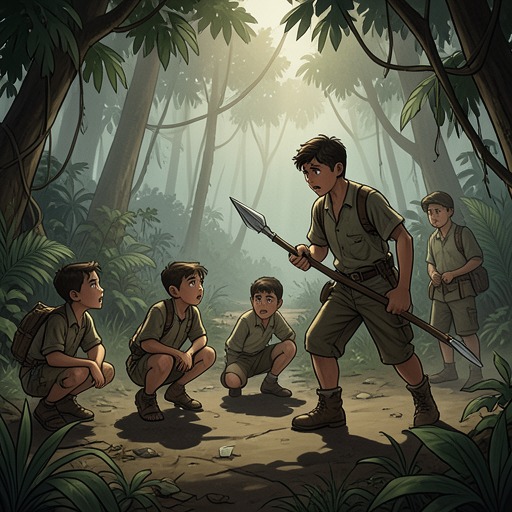
Percival Wemys Madison
Lord of the FliesPercival Wemys Madison is one of the youngest boys stranded on the island, and his recurring distress makes the costs of isolation visible in small, intimate scenes. At first his full home address serves as a fragile link to the life he has lost; later, even that familiar recitation fails him. His episodes of withdrawal, crying, sleep, and fear place the youngest boys’ vulnerability alongside the larger breakdown of the boys’ shared order.
Identity and Early Retreat
Percival belongs to the group known as The littluns, the younger boys distinguished from the older boys by their size and age. The youngest are described as leading a separate, intense life: they spend much of the day eating fruit, suffer stomachaches and chronic diarrhoea, fear the dark, and gather together for comfort. Their days also contain play on the sand beside the water. Percival’s experience gives that general portrait an individual shape. Early in their time on the island, he crawls into a shelter and remains there for two days, talking, singing, and crying. The other boys regard him as odd and are faintly amused, but the retreat is not a passing performance: afterward he is peaked, red-eyed, and miserable, plays little, and cries often.
The island’s daily rhythm offers little reassurance. Morning invites play, while the heat of noon drives the boys into shade and the sudden darkness leaves the shelters restless. Percival’s two-day withdrawal occurs within this altered routine, in which the boys have not wholly adapted their accustomed pattern of work, play, and food to the island. His distress is therefore both personal and part of the younger boys’ wider exposure to fear, discomfort, and separation from adults.
The Assembly and the Address
Later, during an assembly about the beast, the younger boys push Percival forward and leave him standing alone in the central grass. He looks down at his concealed feet and tries to imagine that he is in a tent. The staging makes his isolation plain: he is surrounded by the assembly, yet retreats mentally toward an enclosed place of safety. His appearance also recalls to Ralph another small boy who had stood similarly; Ralph flinches from the memory. The birthmarked boy has not been seen again, and the passage links Percival’s exposure before the group to the unresolved absence without identifying the two boys as the same child.
Piggy kneels with the conch and asks Percival for his name. Percival turns away into his imagined tent and stays silent. When the question is repeated, the assembly begins chanting it, turning a request for identification into a public demand. Ralph intervenes sharply, and Percival finally recites his full name and address: Percival Wemys Madison, the vicarage at Harcourt St. Anthony, Hants, and a telephone number that he can no longer complete. The address comes out like an incantation rooted deep in sorrow, but it does not restore his composure. His face puckers, tears come, and his crying grows from a silent expression of grief into sustained lamentation.
The outburst passes beyond the assembly’s authority. The boys tell him to stop, but their commands and the threat of physical intimidation cannot end it. His crying seems to hold him upright; it also draws the other youngest boys into their own remembered sorrows, and two cry almost as loudly as he does. Maurice breaks the scene by pretending to fall over and making a clumsy joke of his fall. Percival and the others notice, sniff, and laugh, until even the older boys join in. The shift from shared grief to absurd laughter is brief relief, not a resolution of the fear that brought the assembly together.
Fear of the Beast
As the assembly returns to the beast, Percival becomes drowsy and unsteady. Jack seizes and shakes him while asking where the beast lives. Percival sags in Jack’s grip, then mutters an answer. Released into the company of the others, he falls into the long grass and goes to sleep. Jack reports that Percival said the beast comes out of the sea. The assembly’s laughter dies away as the boys turn their attention toward the lagoon and the open water beyond the reef. Percival’s contribution is small and delivered while he is exhausted, but it gives the feared creature a possible home in the vast, unfamiliar sea and sharpens the group’s uncertainty.
His sleep repeatedly marks the limits of his participation. In the grass, surrounded by the reassuring presence of other people, he drops out of the argument; on another night, after a thin wail rises into an inarticulate cry, Ralph and Simon pick him up and carry him to a shelter. His earlier habit of crying often has thus become part of the group’s nighttime life as well as its assemblies. The boys’ response is practical and gentle: when he is quiet, they take him to shelter rather than leave him alone in the dark.
The Lost Incantation
When rescue arrives, Percival is among the boys on the beach. A naval officer asks whether any adults are with them and then asks how many boys there are. Percival tries to speak, but no more words come. He searches his mind for the address that once poured out of him in distress, and finds that the incantation has faded completely. The change gives his earlier recitation a painful second meaning: it had sounded like an anchor to home, but it could not preserve its force through the boys’ time on the island.
Percival’s silence accompanies Ralph’s inability to count the boys and explain what has happened to their former unity. The officer promises to take them away, but the rescue scene does not return Percival to his earlier self or give him his address back. Instead, his failed recollection stands among the signs of how thoroughly their isolation has unsettled them. Through a child who once could call up his name, home, and telephone number in a torrent of tears, the novel measures the distance between the ordered world those details represented and the frightened, disorganized group found on the beach.